What Is Eco-Friendly Pest Control? Safe & Sustainable Pest Management for Kolkata Homes
Pest control does not have to mean spraying large amounts of pesticide throughout your home. Eco friendly pest control is a more considered approach: identify the pest, understand why it is present, prevent conditions that support the infestation, monitor activity and use the most appropriate control method with the least unnecessary intervention.
For homeowners in Kolkata, this distinction matters. Cockroaches, ants, mosquitoes, termites, rodents and other pests can be encouraged by moisture, food sources, drainage conditions, cracks, building gaps and the humid conditions common across the city.
But there is an important misconception we want to clear up at the beginning:
Eco friendly pest control does not simply mean “chemical-free” or “100% natural.”
In professional pest management, the objective is not to avoid a particular category of product at all costs. The objective is to control the pest effectively while minimizing unnecessary exposure to people, pets and the environment.
This philosophy closely aligns with Integrated Pest Management (IPM), a widely recognized approach promoted by organizations including the U.S. Environmental Protection Agency (EPA).
At Golden Pest Solutions, this is also how we approach pest problems in practice: we first look at the pest, its source and the conditions allowing it to survive before deciding what treatment is actually appropriate.
In this guide, we explain what eco-friendly pest control really means, how it works, which methods can be used, whether it is effective, how eco-friendly termite control differs from home remedies, what it may cost in Kolkata and how to choose a responsible pest-control provider.

What Is Eco-Friendly Pest Control?
Eco-friendly pest control is a pest-management approach that aims to control pests effectively while reducing unnecessary pesticide use and minimizing risks to people, animals and the surrounding environment.
Instead of automatically treating an entire property, a professional approach asks:
- What pest are we dealing with?
- Where is the pest active?
- What is attracting or supporting it?
- How severe is the infestation?
- Where is the pest entering or hiding?
- Can the problem be reduced through sanitation or exclusion?
- Can monitoring or physical control be used?
- Is a pesticide actually necessary?
- If treatment is necessary, can it be applied precisely rather than broadly?
- What can be done to prevent the problem from returning?
This is why we often describe eco-friendly pest management as:
Inspect → Identify → Prevent → Monitor → Target → Evaluate
The goal is not simply to kill as many pests as possible during one visit. The goal is to manage the pest population and the conditions supporting it.
What Does Eco-Friendly Mean in Professional Pest Control?
A genuinely responsible eco-friendly approach can include:
- Inspection and pest identification
- Sanitation and hygiene recommendations
- Moisture management
- Sealing cracks and entry points
- Physical and mechanical control
- Traps and monitoring devices
- Targeted baiting
- Botanical products where appropriate
- Biopesticides where appropriate
- Targeted pesticide application when necessary
- Follow-up monitoring and prevention
The EPA’s Integrated Pest Management framework similarly emphasizes prevention, monitoring and the use of appropriate control methods rather than relying automatically on pesticides.
Source: U.S. Environmental Protection Agency (EPA), Integrated Pest Management (IPM) Principles.
Does Eco-Friendly Pest Control Mean Chemical-Free Pest Control?
No.
This is one of the most important things homeowners should understand. A pest-control treatment can be environmentally responsible without being completely chemical-free.
For example, a professional may determine that a targeted treatment is necessary because a pest infestation has become established. In that situation, avoiding treatment altogether simply because the word “chemical” sounds undesirable may allow the infestation to spread.
The more useful questions are:
What active ingredient is being used?
Why is it necessary?
Where is it being applied?
How much is being applied?
How will human and pet exposure be minimized?
Are label directions being followed?
Could a lower-intervention method work instead?
This is a much more scientifically sensible way to think about eco-friendly pest management.
Natural Does Not Automatically Mean Safe
Neem, essential oils and other plant-derived substances may have pest-management applications, but “natural” does not automatically mean harmless.
Likewise, “chemical” does not automatically mean dangerous. Everything depends on the substance, concentration, route of exposure, application method and circumstances. That is why responsible pest control should be based on risk assessment and correct application, rather than marketing language.
Why Is Eco-Friendly Pest Control Important for Kolkata Homes?
Kolkata homes can experience recurring pest pressure because of a combination of humidity, moisture, food availability, drainage, building construction and pest entry points. During inspections, one of the most important things to understand is that the visible pest is often only part of the problem.

For example:
A homeowner may see cockroaches near the kitchen sink.
The actual issue may involve:
- Moisture beneath the sink
- A leaking pipe
- Food residue
- Gaps around plumbing
- Cracks in cabinets
- Hidden harbourage
- Movement through drainage or wall gaps
If you only kill the cockroach you can see, the underlying conditions remain.
That is why an environmentally responsible pest-control strategy tries to answer:
“Why are these pests surviving here in the first place?”
rather than only:
“What can we spray to kill them?”
How Does Eco-Friendly Pest Control Work?
A professional eco-friendly pest-management program generally follows several stages.
1. Inspect the Property
Before recommending treatment, the property should be examined for signs of pest activity.
Depending on the pest, an inspection may look for:
- Live or dead insects
- Droppings
- Gnaw marks
- Pest trails
- Eggs or egg cases
- Nests
- Damage to wood
- Entry points
- Cracks and gaps
- Food sources
- Water sources
- Moisture
- Harbourage areas
- Previous treatment signs
For termites, inspection may also include vulnerable wooden components, wall areas and locations where moisture or construction conditions could support activity.
Our Professional View
One of the easiest ways to waste money on pest control is to choose a treatment before understanding the infestation. The inspection should come before the treatment decision not after it.
2. Identify the Pest Correctly
Different pests have completely different biology and behaviour. Cockroaches are not termites. Termites are not ants. Mosquitoes are not flies. Bed bugs are not eliminated using the same strategy as rodents.
Correct identification therefore matters because the treatment method must match the pest’s:
- Feeding behaviour
- Breeding cycle
- Harbourage
- Movement
- Life stage
- Entry route
- Environmental requirements
3. Remove Conditions Supporting the Infestation
Where possible, the conditions allowing pests to survive should be corrected.
This can include:
- Fixing leaking pipes
- Removing standing water
- Improving waste management
- Storing food properly
- Cleaning food spills
- Reducing clutter
- Improving ventilation
- Sealing cracks and gaps
- Installing window screens
- Correcting moisture problems
This is one of the reasons IPM is so important: prevention can reduce dependence on repeated chemical treatment.
4. Monitor Pest Activity
Monitoring tells the pest-control professional whether pests are still active and where activity is concentrated.
Depending on the pest, this may involve:
- Sticky monitors
- Traps
- Pheromone-based monitoring
- Rodent monitoring stations
- Visual inspections
- Smart monitoring devices
- Other pest-detection systems
Monitoring is particularly useful when the objective is targeted treatment rather than blanket application.
5. Use Targeted Control
If treatment is required, the method should be selected according to the pest and the infestation.
Possible methods include:
- Physical exclusion
- Mechanical control
- Traps
- Baits
- Gel baiting
- Botanical products
- Biopesticides
- Targeted pesticide applications
The important word here is targeted.
A professional should know where treatment is required and where it isn’t.
6. Evaluate and Follow Up
Pest management should not always end when the first treatment is completed.
Depending on the pest, follow-up may involve:
- Checking pest activity
- Re-inspecting treated areas
- Replacing monitoring devices
- Correcting property conditions
- Additional treatment where necessary
- Reviewing prevention measures
This is especially important for recurring infestations and pests such as termites, bed bugs and rodents.
What Are the Common Eco-Friendly Pest Control Methods?
There is no single product called “eco-friendly pest control.” Instead, several methods can be combined.
Integrated Pest Management (IPM)
Integrated Pest Management is one of the foundations of modern responsible pest control. Rather than relying entirely on pesticides, IPM combines prevention, monitoring and appropriate control techniques.
A simplified version is:
Identify → Monitor → Prevent → Control → Evaluate
The EPA describes IPM as an effective and environmentally sensitive approach that uses information about pest life cycles and their interaction with the environment to manage pests with the least possible hazard to people, property and the environment.
Physical and Mechanical Pest Control
Physical methods can sometimes reduce pest activity without pesticide application.
Examples include:
- Sealing cracks
- Closing entry points
- Installing screens
- Removing standing water
- Using traps
- Improving waste management
- Removing suitable harbourage
- Correcting structural gaps
These measures are particularly valuable for long-term prevention.
Baits and Targeted Treatments
Baiting is another important technique. For cockroaches, for example, gel bait can be placed strategically near harbourage and activity areas instead of automatically spraying an entire room.
This allows treatment to be concentrated where it is most useful. The exact product and placement should depend on the pest, infestation and product label instructions.
Botanical Pest Control
Some pest-control products contain active ingredients derived from plants. Neem is one example frequently discussed in natural pest management. However, botanical products should not be treated as a universal answer.
A product being plant-derived does not automatically mean:
- It will work against every pest.
- It will eliminate an established infestation.
- It is risk-free.
- It can be used at any concentration.
- It can replace professional treatment in every situation.
The pest and evidence of infestation should determine the treatment—not the word “natural” on the packaging.
Biopesticides
Biopesticides are another area of sustainable pest management. They can include certain substances derived from living organisms as well as microbial or naturally occurring pest-control agents.
Is Eco-Friendly Pest Control Really Effective?
Yes, eco-friendly pest control can be highly effective when the method matches the pest and the infestation. But it is important not to confuse eco-friendly pest management with simply using a weaker product.
Consider two different situations.
Situation 1: Cockroaches
An appropriate strategy may combine:
- Sanitation
- Moisture control
- Harbourage reduction
- Monitoring
- Targeted gel baiting
- Sealing entry points
- Follow-up
Situation 2: Termites
Termites require a completely different approach because colonies can remain hidden and damage may occur inside wood or inaccessible areas.
The strategy may require:
- Inspection
- Locating activity
- Identifying vulnerable areas
- Addressing moisture or conducive conditions
- Targeted termite treatment
- Monitoring
- Follow-up
So the question should not be:
“What is the most natural pest-control product?”
A better professional question is:
“What is the least unnecessary intervention that can still provide reliable control of this particular infestation?”
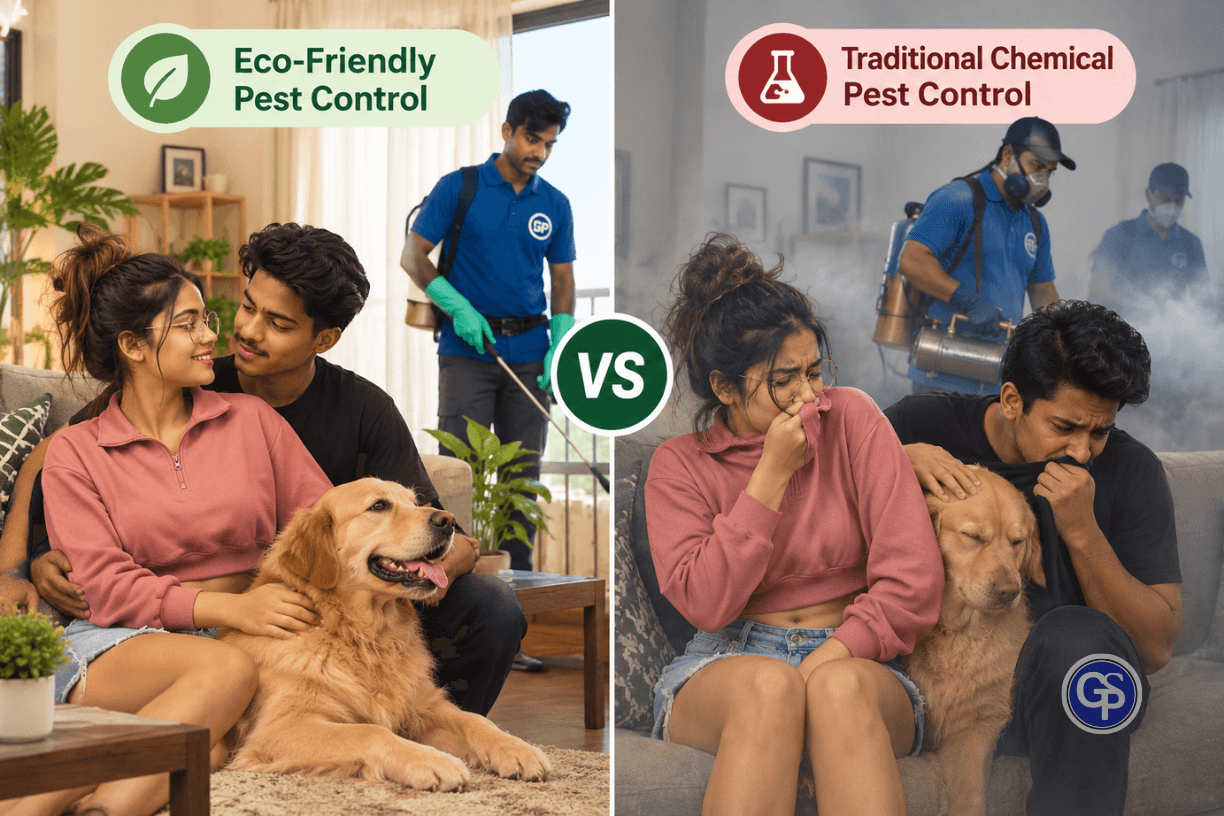
Eco-Friendly Pest Control vs. Traditional Chemical Pest Control
| Factor | Eco-Friendly / IPM Approach | Conventional Chemical-First Approach |
|---|---|---|
| Main Focus | Prevention, monitoring and targeted control | Direct pest treatment |
| Pest Identification | Important | Important |
| Monitoring | Often emphasized | Depends on provider |
| Prevention | Strong focus | Varies |
| Chemical Use | Minimized or targeted where appropriate | Depends on product and application |
| Environmental Considerations | Explicitly considered | Depends on product and application |
| Long-Term Management | Addresses conditions supporting pests | May focus primarily on immediate control |
| Follow-Up | Often part of the strategy | Depends on service |
That is much closer to the philosophy of IPM. This table does not mean conventional pesticides are automatically unsafe.
A properly selected and correctly applied pesticide can be an important part of professional pest management.
The difference is that an IPM-oriented approach asks whether pesticide application is necessary, appropriate and targeted.
Is Eco-Friendly Pest Control Safe for Children and Pets?
This needs a more careful answer than simply saying “yes.”
No responsible pest-control professional should promise that every treatment is completely risk-free.
Safety depends on:
- The active ingredient
- Concentration
- Application method
- Location
- Amount applied
- Exposure route
- Ventilation
- Household occupants
- Product instructions
- Re-entry requirements
For households with children or pets, ask your pest-control provider:
- What product or active ingredient are you using?
- Where will it be applied?
- Why is this treatment necessary?
- How much will be used?
- How long should children stay away?
- How long should pets stay away?
- Do food items need to be covered?
- Does the kitchen require preparation?
- When can normal activity resume?
Always follow the specific preparation and re-entry instructions provided for the treatment. For general pesticide safety information, the National Pesticide Information Center (NPIC) provides independent educational resources on pesticide exposure and safety.
What Pests Can Be Controlled Using Eco-Friendly Methods?
Eco-friendly principles can be applied to many common pests, including:
- Cockroaches
- Ants
- Termites
- Mosquitoes
- Rodents
- Flies
- Spiders
- Bed bugs
However, the method changes according to the pest.
Eco-Friendly Cockroach Control
A professional cockroach-management strategy can include:
- Removing food sources
- Removing water sources
- Improving sanitation
- Identifying harbourage
- Monitoring activity
- Targeted gel baiting
- Sealing gaps
- Treating specific activity areas
A common mistake
People often focus on killing the cockroaches they can see.
But cockroaches spend much of their time hiding.
If harbourage, food and moisture remain available, the infestation can continue.
Eco-Friendly Ant Control
Ant control starts with understanding the trail.
Professionals may look for:
- Where ants are entering
- Where they are feeding
- Where trails are forming
- Whether food sources are available
- Where the colony may be located
Control may then involve sanitation, exclusion, monitoring and targeted baiting.
Eco-Friendly Mosquito Control
For mosquitoes, source reduction is one of the most important parts of prevention.
Look for water-holding locations such as:
- Plant pots
- Containers
- Roof areas
- Drains
- Gutters
- Buckets
- Discarded items
- Other areas where water can collect
If mosquitoes are breeding in standing water, killing adult mosquitoes alone may provide only temporary relief. The CDC and WHO both emphasize mosquito-breeding-site management and prevention as important components of mosquito and mosquito-borne disease control.
What Is Eco-Friendly Termite Control?
Eco-friendly termite control means managing termite activity using prevention, inspection, monitoring and appropriately targeted treatment while avoiding unnecessary intervention.
This is particularly important because termites are not simply surface insects that can always be eliminated by spraying whatever natural substance is available.
An established termite infestation can remain hidden and may cause damage to:
- Wooden furniture
- Door frames
- Flooring
- Wooden structures
- Wall areas
- Other cellulose-containing materials
That is why we strongly recommend professional termite inspection when there are signs of active termites.
How Does Eco-Friendly Termite Control Work?
A responsible termite-management program can involve:
1. Inspection
Look for:
- Mud tubes
- Termite activity
- Damaged wood
- Hollow-sounding timber
- Swarmers or discarded wings
- Moisture
- Entry points
- Areas vulnerable to termite attack
2. Identify the Source and Conditions
The professional should determine how termites may be accessing the property and which conditions are supporting activity.
3. Preventive Measures
Depending on the property, prevention can include moisture management, correcting conducive conditions and reducing unnecessary contact or access points.
4. Targeted Treatment
Where active termite treatment is required, an appropriate professional termite-control product or treatment method may be used according to its label and professional protocol.
For some structures, targeted drilling and injection may be appropriate where the construction and termite activity make that treatment necessary.
The point is not to avoid every chemical treatment.
The point is to avoid unnecessary treatment and apply the necessary treatment precisely.
5. Follow-Up
Termite management should be monitored rather than assuming that visible signs disappearing immediately means the entire problem has been resolved.
Learn more about termite treatment while moving to a new house from our latest blog on Termite Treatment Before or After Renovation?
Why Neem Alone Is Not a Termite Treatment Strategy
Neem and other botanical substances may have pest-management properties, but homeowners should be careful about treating them as a guaranteed solution for established termites. If termites are already damaging furniture or structural wood, the priority should be:
Identify → Inspect → Assess → Treat appropriately → Monitor
not:
Find a natural ingredient → Spray it everywhere → Assume the colony is gone.
For serious termite activity, professional inspection is the safer decision.
Is Natural Pest Control the Same as Eco-Friendly Pest Control?
No.
These terms are frequently mixed together in online marketing.
Natural pest control
Usually emphasizes naturally derived substances or non-chemical methods.
Eco-friendly pest control
Is broader and can include:
- Prevention
- Exclusion
- Monitoring
- Mechanical control
- Biological control
- Botanical products
- Baits
- Targeted chemical treatment
- Reduced pesticide use
So an environmentally responsible treatment does not necessarily have to be completely natural. Likewise, a natural product is not automatically environmentally harmless.
Eco-friendly pest management is about the entire pest-control process, not simply the source of one ingredient.
What Are the Benefits of Eco-Friendly Pest Control?
A properly designed program can provide several advantages.
1. Less Unnecessary Pesticide Use
Targeted treatment can reduce indiscriminate applications.
2. Prevention Instead of Repeated Emergency Treatment
Fixing leaks, removing standing water and sealing entry points can reduce the conditions that allow pests to thrive.
3. Better Treatment Planning for Families and Pets
The treatment can be planned around household occupants and appropriate precautions.
4. Environmental Consideration
Using only the treatment that is necessary can help reduce unnecessary pesticide exposure.
5. Better Long-Term Pest Management
Monitoring and prevention can be particularly useful for recurring pest problems.
What Are the Limitations of Eco-Friendly Pest Control?
Eco-friendly pest management is not a magic shortcut.
Depending on the pest, it may require:
- More monitoring
- Multiple visits
- Homeowner cooperation
- Sanitation improvements
- Moisture correction
- Structural repairs
- Follow-up treatment
- Patience
Some natural repellents may also provide only temporary results. For a severe infestation, professional treatment using an appropriate registered pest-control product may be necessary. That is not a failure of eco-friendly pest control. It is simply good pest management.
Can You Do Eco-Friendly Pest Control Yourself?
Yes—there is plenty you can do to prevent pest problems.
At home, you can:
- Keep food in sealed containers
- Clean spills promptly
- Keep kitchens dry
- Repair leaking taps and pipes
- Remove standing water
- Keep garbage covered
- Seal cracks and gaps
- Install window screens
- Reduce unnecessary clutter
- Inspect for early pest activity

But there is an important difference between prevention and treating an established infestation.
DIY measures may not be sufficient when you have:
- Active termites
- Repeated cockroach infestations
- Bed bugs
- Rodent activity
- Persistent mosquito breeding
- Large infestations
- Pests spreading to multiple rooms
- An infestation that continues after DIY treatment
When Should You Hire a Professional Pest Control Service?
Consider professional pest control when:
- You cannot confidently identify the pest.
- The infestation keeps returning.
- You are seeing signs of termites.
- Rodents are entering the property.
- Bed bugs are spreading.
- Mosquito breeding is persistent.
- The infestation is affecting several areas of the property.
A professional inspection can help answer the most important question:
“Do I actually need treatment, and if so, what treatment makes sense?”
That question alone can prevent homeowners from spending money on unsuitable products.
Read our guide for home owners who wants to conduct a whole house pest control Complete Whole House Pest Control in Kolkata: What Every Homeowner Should Know
How to Choose an Eco-Friendly Pest Control Service in Kolkata
Don’t choose a company simply because its advertisement says:
“100% Natural.”
Ask better questions.
Before booking, ask:
- What pest-control method will you use?
- What active ingredient is involved, if any?
- Why is that method suitable for my infestation?
- Do you follow IPM principles?
- Where exactly will treatment be applied?
- What preparation is required?
- How long should children and pets stay away?
- What precautions are required after treatment?
- Is follow-up monitoring included?
- Is there a treatment warranty where applicable?
- Will you inspect the property before recommending treatment?
A trustworthy pest-control provider should be able to explain what they are doing, where they are doing it and why. That is a much stronger trust signal than simply calling a treatment “green.”
Our Approach to Eco-Friendly Pest Management in Kolkata
At Golden Pest Solutions, we don’t believe responsible pest control means automatically choosing the product with the most attractive “natural” label.
Our approach starts with the infestation itself.
We look at:
- The pest
What species or pest group are we dealing with? - The activity
Where are we finding evidence of infestation? - The conditions
What food, water, moisture, harbourage or entry points are supporting the pest? - The property
Is it an apartment, independent house, office, commercial property or another structure? - The appropriate intervention
Can prevention, exclusion, monitoring or targeted treatment solve the problem? - Follow-up
What needs to happen to reduce the chance of the pest returning?
This matters because good pest control is not simply about applying a product.
It is about understanding pest behaviour and the environment in which the pest is surviving.
That is the practical side of Integrated Pest Management that homeowners don’t always see.
How Much Does Eco-Friendly Pest Control Cost in Kolkata?
There is no single price for eco-friendly pest control in Kolkata.
The cost can depend on:
- Pest species
- Property size
- Infestation severity
- Treatment method
- Number of visits
- Follow-up requirements
- Residential or commercial property
- Accessibility of the affected areas
For example, treating a small cockroach infestation is very different from managing an established termite problem affecting furniture or a larger structure.
So a very low advertised price does not necessarily mean better value.
A professional inspection and appropriate treatment plan can be more useful than choosing a service solely because it advertises the cheapest fixed rate.
Read the total cost of pest control How much does pest control cost in Kolkata?
What Are the Latest Eco-Friendly Pest Control Technologies?
The pest-control industry is increasingly moving toward precision, monitoring and data, rather than simply increasing the amount of pesticide applied.
Smart Monitoring
Connected traps and monitoring devices can help identify pest activity and reduce the need for routine blanket treatment in suitable commercial applications.
Camera-Based Detection
Computer vision and camera systems are being researched and developed for automated pest detection and monitoring. The important potential advantage is early detection.
Pheromone Monitoring
Pheromone-based traps can help detect and monitor particular insect populations.
Botanical Formulations
Researchers continue to investigate plant-derived compounds and improved formulations for pest management.
Biopesticides
Microbial and biological approaches are another important area of research and development.
The broader direction is encouraging:
Detect earlier → understand better → target more precisely → avoid unnecessary treatment.
That philosophy fits naturally with IPM.
Eco-Friendly Pest Control: What Homeowners Should Remember
If you remember only five things from this article, remember these:
1. Eco-friendly does not automatically mean chemical-free.
2. Natural does not automatically mean safe or effective.
3. Inspection and prevention are just as important as treatment.
4. Established termite, bed bug and rodent infestations should not be treated as simple DIY problems.
5. The best eco-friendly strategy is usually the one that controls the pest effectively with the least unnecessary intervention.
Frequently Asked Questions About Eco-Friendly Pest Control
Conclusion: Is Eco-Friendly Pest Control Right for Your Kolkata Home?
Eco-friendly pest control is not simply about replacing every pesticide with a natural ingredient.
It is about managing pests intelligently.
That means:
Identify the pest.
Find the source.
Understand the conditions supporting it.
Prevent what can be prevented.
Monitor activity.
Treat only where treatment is necessary.
Use the appropriate method.
Follow up when required.
For Kolkata homes, this approach can be useful for common pest problems such as cockroaches, ants, mosquitoes, rodents and termites.
And when you are dealing with recurring pests or signs of termite activity, don’t rely only on trial-and-error remedies.
Get the infestation properly assessed.
At Golden Pest Solutions, our focus is on practical pest management: understanding the property, identifying the pest problem and choosing an appropriate treatment strategy rather than treating every infestation exactly the same way.
Because in professional pest control, “green” should not just be a marketing word—it should be reflected in how the entire pest-management process is planned and carried out.